

The Names of God: Adonai, Our Lord and Master

God is called by many different names throughout the Bible. Some of these names were given to Him by His people, while others He revealed about Himself. Each one teaches us something unique about His character and helps us understand Him more deeply. As we study God’s Hebrew names, we not only learn the meaning of ancient words, but we also gain a greater appreciation for who He is and how He relates to His people.
One of the most familiar Hebrew names of God is Adonai (אֲדֹנָי). But what does Adonai mean? Why do some Bibles translate it as “Lord,” while others use “LORD” in all capital letters? And what can this name teach us about our relationship with God today?
In this article, we’ll explore the meaning of Adonai and several related Hebrew titles that reveal God as our Lord, Master, and King.
This article covers the name Adonai and those related. If you’re interested in more names of God, here are others in this series you may enjoy.
The Names of God: Revealing God’s Personality Traits
The Names of God: יהוה, the God of Israel
The Names of God: Elohim, The Mighty One
Find the free printable PDF Names of God Chart here!
If you’re new to the Hebrew language, it may be helpful to start with my posts on the Hebrew Alphabet and the Hebrew Vowels. You’ll also find my Hebrew Language Resources page helpful.
Adonai (אֲדֹנָי)
Pronunciation: ah-doe-NYE
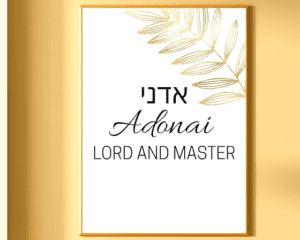
Meaning: Lord or Master
The Hebrew name Adonai means “Lord” or “Master.” It emphasizes God’s authority, sovereignty, and rightful rule over all creation. While some names of God reveal His power, mercy, or faithfulness, Adonai reminds us that He is the One who deserves our love, worship, and obedience.
Throughout the Old Testament, God’s people recognized Him not only as their Creator but also as their Lord. Calling Him Adonai acknowledged that He alone has the right to direct their lives. It is a title of reverence, humility, and complete trust.
Why do some Bibles say “Lord” while others say “LORD”?
If you’ve ever wondered why your Bible sometimes uses “Lord” and other times “LORD,” you’re not alone. This is one of the most common questions people have when studying the names of God.
When Adonai appears in the Hebrew Scriptures, English Bible translators usually render it as “Lord,” with only the first letter capitalized.
“LORD,” written in all capital letters, is different. In most English translations, LORD represents God’s covenant name, יהוה (often written as YHWH or Yahweh). Rather than attempting to pronounce this sacred name, Jewish readers have traditionally substituted Adonai whenever they encountered יהוה while reading Scripture aloud. This practice developed out of deep reverence for God’s holy name and continues in many Jewish and Messianic communities today.
Understanding this distinction makes Bible study much easier. When you see LORD in all capital letters, it almost always represents יהוה. When you see Lord, it usually translates Adonai.
Sometimes these names appear together as Adonai יהוה (אֲדֹנָי יַהְוֶה). Because translating this literally would read “Lord LORD,” many English Bibles instead translate it as “Lord GOD,” with GOD printed in small capital letters. This helps readers distinguish between the two Hebrew words.
Adon and Adonai
Adonai is an extended form of the Hebrew word Adon (אָדוֹן), which simply means “lord” or “master.” Depending on the context, Adon may refer to God, a human master, a king, or even an angel.
Adonai, however, is used almost exclusively as a title of honor and reverence for God. It reminds us that He is not only our Creator but also the rightful King over all creation.
Recognizing God as Adonai changes the way we approach Him. We come before Him with humility, trusting that His wisdom is greater than ours and that His plans are always good.
Adoni (אֲדֹנִי)
Sometimes you’ll see the Hebrew word Adon in different forms throughout Scripture. One of these is Adoni (אֲדֹנִי), which means “my lord” or “my master.”
Unlike Adonai, which is used almost exclusively as a title for God, Adoni is most often used for a human master, king, or someone in a position of authority. The exact meaning depends on the context.
One of the best-known examples appears in Psalm 110:1:
“The LORD says to my Lord…”
This remarkable psalm is one of the most frequently quoted passages in the New Testament because it points to the coming Messiah. David prophetically speaks of one greater than himself, whom he calls “my Lord.”
Although the Hebrew words differ, both Adonai and Adoni remind us that God is the ultimate authority over our lives. As believers, we can joyfully proclaim Him as our Lord and willingly submit to His loving leadership.
Adoneinu (אֲדֹנֵנוּ)
Adoneinu means “our Lord” or “our Master.”
What a beautiful reminder that God is not only the Lord of individuals but also the Lord of His people. Throughout Scripture, He continually calls a people to Himself, inviting them into covenant relationship.
It is amazing to think that the Creator of heaven and earth allows us to call Him “our Lord.” He is not distant or uninvolved. He desires to dwell among His people and faithfully care for them.
This word can also be spelled אֲדֹנֵינוּ. The pronunciation remains the same, although the spelling varies depending on the grammatical form. In some passages it refers to God, while in others it refers to a human ruler, such as King David. Examples of these different uses can be found in Psalm 8:1 and 1 Kings 1:43.
Adonei HaAdonim (אֲדֹנֵי הָאֲדֹנִים)
Adonei HaAdonim means “Lord of lords.”
One of the clearest examples appears in Deuteronomy 10:17:
“For the LORD your God is God of gods and Lord of lords, the great, mighty, and awesome God, who shows no partiality and accepts no bribes.”
This title reminds us that no earthly ruler, spiritual authority, or kingdom can compare with God’s power. Every authority ultimately answers to Him because He alone reigns over all.
The surrounding verses in Deuteronomy 10 are well worth reading. Moses reminds Israel not only of God’s greatness but also of His justice, mercy, and faithfulness. He calls His people to fear the Lord, walk in His ways, love Him, and serve Him with all their heart and soul. If you have a few moments today, take time to read Deuteronomy 10:12-22. It provides a beautiful picture of God’s character and His desire for His people.
Adon Yahweh Tsevaot (אָדוֹן יְהוָה צְבָאוֹת)
This powerful title is commonly translated “Lord GOD of Hosts” or “Lord GOD of Armies.”
The Hebrew word Tsevaot (or Sabaoth in some English spellings) means “hosts” or “armies.” These hosts include both the heavenly armies, such as God’s angels, and the earthly armies under His sovereign authority.
This title reminds us that every power in heaven and on earth is under God’s command. No battle is too great for Him, and no enemy is beyond His authority.
One of the most memorable uses of this title occurs when David confronts Goliath. While Goliath trusted in armor, weapons, and military strength, David declared:
“You come to me with a sword and with a spear and with a javelin, but I come to you in the name of the LORD of Hosts, the God of the armies of Israel, whom you have defied.” (1 Samuel 17:45)
David’s confidence was not in himself but in the God who commands the armies of heaven. The victory belonged to the Lord long before David ever picked up a stone.
What encouragement this brings to us today. Whatever battle we face, whether physical, emotional, or spiritual, our God is still the Lord of Hosts. Nothing is beyond His power.
Adon Kol HaAretz (אֲדוֹן כָּל הָאָרֶץ)
Adon Kol HaAretz means “Lord of all the earth” or “Lord of the whole earth.”
This beautiful title appears in several places throughout Scripture, including Psalm 97:5:
“The mountains melt like wax before the LORD, before the Lord of all the earth.”
Psalm 97 celebrates God’s majesty, righteousness, and kingship over all creation. It paints a breathtaking picture of His glory and reminds us that every nation, every ruler, and every person ultimately belongs under His authority.
The title also appears in Joshua 3 as Israel prepares to cross the Jordan River into the Promised Land. God demonstrates His power by stopping the waters of the Jordan, revealing Himself as the Lord over all creation. Nothing in heaven or on earth can stand in the way of His purposes.
Whether we look at towering mountains, vast oceans, or the nations of the world, everything belongs to Him. He truly is the Lord of all the earth.
What Does Adonai Mean for Believers Today?
Learning the meaning of Adonai is about much more than adding another Hebrew word to our vocabulary. Every name God reveals about Himself invites us to know Him more personally, and Adonai reminds us that He is our Lord and Master.
In a world that encourages us to follow our own hearts and pursue our own plans, Scripture calls us to something much greater. Calling God Adonai means recognizing His authority over every part of our lives. It means trusting His wisdom above our own, obeying His commands even when they are difficult, and believing that His plans are always for our good.
Thankfully, God is not a harsh master. He is compassionate, faithful, patient, and full of mercy. The One who rules over all creation also knows each of us by name and lovingly cares for His children. We can surrender our lives to Him with confidence because His leadership is perfect.
The next time you encounter the name Adonai in Scripture or hear it spoken in prayer, take a moment to reflect on what it means. He is the Lord of all the earth, yet He invites us into a personal relationship with Him. What an incredible privilege it is to call Him our Lord.
Key Takeaways
• Adonai means “Lord” or “Master.”
• Adonai emphasizes God’s authority, sovereignty, and rightful rule over all creation.
• Most English Bibles translate Adonai as “Lord,” while “LORD” in all capital letters usually represents the divine name יהוה.
• Jewish tradition has long substituted Adonai when reading יהוה aloud out of reverence for God’s holy name.
• Related titles such as Adoneinu, Adonei HaAdonim, and Adon Kol HaAretz reveal additional aspects of God’s character and authority.
• Recognizing God as Adonai calls us to trust Him, obey Him, and joyfully submit to His loving leadership.
Frequently Asked Questions About Adonai
What does Adonai mean?
Adonai is a Hebrew title meaning “Lord” or “Master.” It emphasizes God’s authority, sovereignty, and rightful place as the ruler over all creation.
Is Adonai God’s name?
Adonai is best understood as a title rather than God’s personal covenant name. In the Hebrew Scriptures, God’s covenant name is יהוה (often written as YHWH). Adonai describes His role as Lord and Master.
Why do Jews say Adonai instead of יהוה?
Out of deep reverence for God’s holy name, Jewish tradition developed the practice of saying “Adonai” whenever the divine name יהוה appeared in Scripture during public reading or prayer. This custom continues in many Jewish and Messianic communities today.
What is the difference between Adonai and Yahweh?
Adonai means “Lord” or “Master” and emphasizes God’s authority. יהוה is God’s covenant name revealed to Moses in Exodus 3. In many English Bibles, יהוה is translated as “LORD” in all capital letters, while Adonai is translated as “Lord.”
Is Adonai used in the New Testament?
The Hebrew word Adonai does not appear in the Greek text of the New Testament. However, the Greek word Kyrios, meaning “Lord,” is frequently used for both God the Father and Jesus. This reflects the same understanding of God’s authority and lordship found in the Old Testament.
Continue Studying the Names of God
If you’ve enjoyed learning about Adonai, I invite you to continue exploring the richness of God’s Hebrew names.
Be sure to read:
The Names of God: Revealing God’s Personality Traits
The Names of God: יהוה, the God of Israel
The Names of God: Elohim, The Mighty One

Every name God reveals in Scripture teaches us something about His character. As we grow in our understanding of His names, we grow in our understanding of Him. My prayer is that this study encourages you to worship Him more deeply, trust Him more fully, and draw ever closer to the One who is our Lord, our Master, and our King.
Comments (3)
Leave a Reply

Need a how-to guide for your Passover Seder? Do you want detailed instructions on how to keep the Sabbath? Here’s a book with all you need, including explanations, recipes, blessings, and more! It will be a useful resource on your Hebraic faith journey!
Join What God Is Doing in Africa!
Looking for a place to give that truly aligns with your faith? Discover a Messianic ministry in Zambia that is not only sharing the truth of Scripture, but transforming lives through education, care, and discipleship. Learn how you can help raise up the next generation here.

Do you love the Holy Land? Artzabox brings the Holy Land to your door!
Get 20% off with coupon code HEBREW20

Your work is marvelously extensive and thoughtful. How often have you been confronted with the cultish assertion that “God” and “Lord” are pagan — even Satanic — substitutions for the Almighty’s Name?
I have heard a lot about this recently and I can see both sides of this argument. However, I find a bitter spirit of disunity among Believers due to this issue and others which is displeasing to God and hinders our ability to disciple others. We will always have differences in beliefs and how we practice them but I wish we could focus more on what unites us as God’s people, rather than what we disagree on.
I use terms like “God” and “Jesus” with my audience because those are what they’re most familiar with and I would like my info to be very clear to those who seek it. I tend to use more specific terms with my family and faith community, as we all have similar views. Ultimately, each individual needs to seek guidance from the Spirit on what words they use to describe God and be sensitive to any conviction where changes are needed.
I even recognize John as Yohhanan